
Warmer floors, lower bills, drier home.
Heavy-duty vapor barriers and properly installed insulation that keep ground moisture out and conditioned air in, the workhorses of a healthy crawl space.
Two of the most common things we find in a Georgia crawl space are a torn sheet of thin plastic doing nothing on the dirt, and sagging, moldy fiberglass batts falling out of the floor joists. Both are doing the opposite of their job. The fix is not exotic, it is doing it right.
The right barrier, the right insulation, installed to stay put. We lay a reinforced vapor barrier rated for foot traffic and mechanically fasten it, and we insulate in the way that actually works for a sealed crawl space in our climate, so your floors are warmer in winter and your bills are lower year-round.
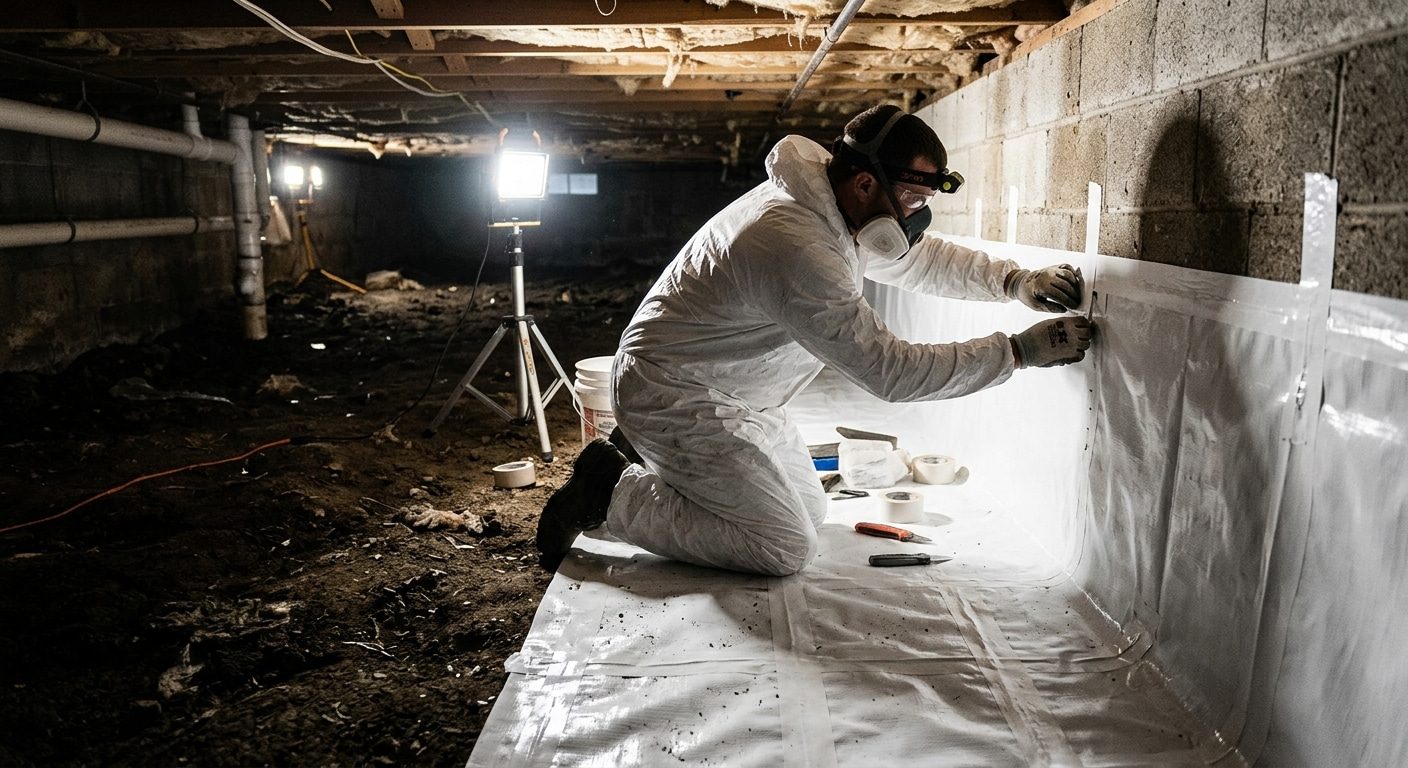 Heavy-duty vapor barrier being installed by hand
Reinforced barrier tough enough to crawl on, fastened and taped, not thin plastic loose on the dirt.
Insulated the way a sealed crawl space should be for our climate, so warm floors do not mean sky-high bills.
Sealed vents and real insulation keep Georgia cold snaps from walking in under your feet.
The barrier stops soil moisture from wicking up into the space, the first line of a dry crawl space.
Seams taped, piers wrapped, edges sealed. It stays where we put it, for years.
The free inspection settles it, with photos of your actual crawl space.
Ask the DoctorsA free inspection with photos, moisture readings, and an honest diagnosis. If you do not need this service, we say so.
You see exactly what we saw, with a firm written scope. No commissioned upsell, no expiring-tonight pressure.
One crew does the job to the plan you approved, clean, with no surprise add-ons mid-job.
Photos of the finished work, our written guarantees, and a crawl space that stays healthy.
A vapor barrier is one component; encapsulation is the whole system. The barrier covers the floor (and often the walls) to block ground moisture. Full encapsulation adds sealed vents, sealed walls, and usually a dehumidifier. Some homes only need a fresh, properly installed barrier; others need the whole envelope. The inspection tells you which.
Most of the plastic we find is thin painter's-grade sheeting, torn, and loose on the dirt, which does very little. A real vapor barrier is a heavy, reinforced material, mechanically fastened, taped at the seams, and run up the piers and walls. It is the difference between a token gesture and an actual moisture block.
It depends on whether the space is vented or sealed. For a sealed, encapsulated crawl space in our climate, insulating the walls is usually the better approach; for some vented spaces, floor insulation still has a role. We do not apply a one-size template, we insulate for how your specific space is built and conditioned.
Usually, yes. A sealed, insulated crawl space stops your HVAC from fighting humid, unconditioned air rising through the floor, and keeps winter cold out. Most homeowners feel it first as warmer floors and more even temperatures, and see it over time on the bill.
We inspect, photograph, and tell you honestly what you do and do not need. Serving Athens, Gainesville and Augusta from Madison, GA.
Prefer to talk?706-608-7179
The Doctors will call you to schedule your free inspection. Talk soon.