
Water Where It Should Not Be, Found Fast
Unexplained increases in your water bill, damp or moldy spots, and hissing sounds are all signs of a hidden leak. Left alone, a small leak causes damage you can't see until it's expensive.
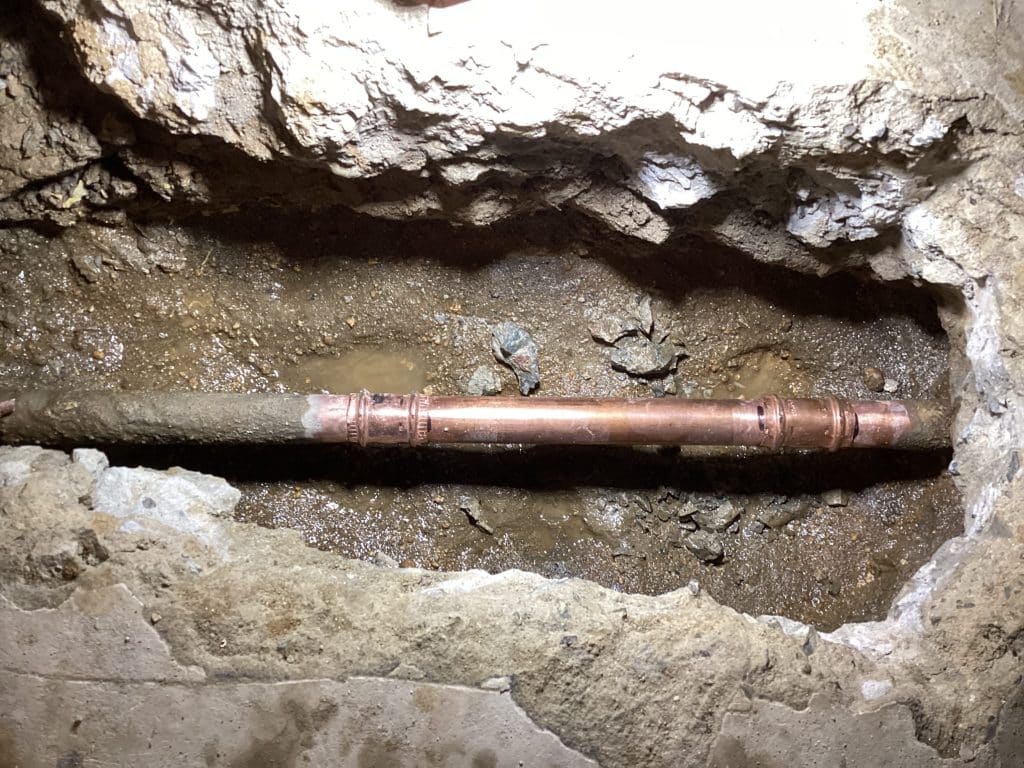
Our technicians locate leaks with non-invasive methods first: thermal imaging cameras, acoustic listening equipment, and tracer gas. When a leak hides deeper, video inspection cameras find it before anyone opens a wall or a slab. That photo on the right is one of ours: an underground supply line located, opened, and repaired with new copper.
A warm spot on the floor or the sound of running water under concrete. We pinpoint slab leaks electronically and repair with minimal demolition, like our recent slab jobs in Carlsbad and Escondido.
Sensitive listening equipment picks up the sound of water escaping a pressurized line, locating the leak without opening walls.
Temperature differences reveal moisture inside walls and ceilings before there is visible damage.
A gas leak is an emergency. We locate and repair gas line leaks safely and to code. If you smell gas, leave the building first, then call.
Once found, we fix it: spot repairs, reroutes, or a whole-home repipe when old pipe has reached the end of its life.
When the source is not obvious, an in-pipe camera shows exactly what is happening so the repair is accurate the first time.
A leak you cannot see is still costing you every day. These are the ways one usually announces itself.
A water bill that climbs with no change in habits is the most common way a hidden leak shows up first.
Shut every fixture in the house, then watch the meter. If it is still moving, water is going somewhere it should not.
A warm patch on a slab usually means the hot side of a line under the concrete is leaking beneath your feet.
Hearing water with nothing switched on means it is moving inside a wall, a ceiling or the slab.
Water behind drywall shows up as a smell before it shows up as a stain. Either way it has been going a while.
Moving water washes out the ground under a slab or patio. Fresh cracks near a plumbing run are worth a look.
Both find the leak in the end. The difference is how much of your house is open when we get there.
| Electronic Detection | Guess And Cut | |
|---|---|---|
| Where we start | Meter, pressure and acoustic readings | The most likely wall |
| Your drywall | One opening, at the leak | Several openings, hoping one is right |
| Your slab | Located before any concrete is cut | Cut, look, cut again |
| Time to an answer | Usually the same visit | As long as the guessing takes |
| What you are shown | The reading and the location | Whatever the last hole revealed |
| Cost of being wrong | A repeated scan | A repaired wall that was never the leak |
| What we do | This, on every leak call | Not how we work |
We inspect the property, check the meter, and review the visible evidence to narrow down where the leak lives.
Thermal imaging, acoustic listening, and tracer methods find the leak precisely, so we open one spot instead of five.
You get repair options with upfront prices. After the fix, we verify the line holds pressure and document the work.
"We are very happy with the plumbing work that Estevan did in our bathroom. He is very knowledgeable and explained everything to me. He was very respectful of our home and everything was left clean and perfect when he was finished."
"Cesar was very knowledgeable and professional. He knew what the problem was and resolved our issue very quickly! Would highly recommend Hack's Plumbing & Drain to my family and friends!!!"
When the leaks stop being one-offs, repiping ends the cycle.
See Whole-House RepipingA soggy yard is more often the sewer lateral than a supply line.
See Sewer Line RepairNeighborhood-level notes for the eight cities we publish, from coastal corrosion to hard water inland.
See Service AreasA hidden leak gets more expensive every week. Tell us what you're seeing and we'll get a licensed technician out with detection equipment and an upfront price.